Showing posts with label poetry. Show all posts
Sunday, April 16, 2023
The Word and the Line
Poetry empowers the simplest of lives to confront the most extreme sorrows with courage, and motivates the mightiest of offices to humbly heed lessons in compassion.
― Aberjhani
I’m a great believer in poetry out of the classroom, in public places, on subways, trains, on cocktail napkins. I’d rather have my poems on the subway than around the seminar table at an MFA program.
— Billy Collins
The world is full of poetry. The air is living with its spirit; and the waves dance to the music of its melodies, and sparkle in its brightness.
— James Gates Percival
As you might have guessed from the above quotes, workshop number six, run by Paul Vermeersch, was one of the two workshops that dealt with poetry. He began by talking about words themselves.
Words matter, ideas don’t. It’s the execution of the idea that makes a word good or bad. Words don’t just say things, they do things. Choosing the right word matters. When words are doing something different than what they’re supposed to, that’s ironic.
The right word can create tone or mood, give connotation or texture to your work, and rhythm and speed to your poem. Polysemy is a word or phrase chosen to mean many things.
He then went on to cite Canadian poet Dennis Lee, whose careful choice of words is apparent in his work. He’s not trying to say something, he’s trying to do something. He often starts with a sound and there’s a strong rhyme and rhythm to his poetry that continues its musical quality.
It’s really a matter of following, not my nose, but my ear, hearing what the poem wants to be. I may be as surprised by the end of it as the reader is.
— Dennis Lee
Then we were asked, what is the poetic line?
The line is the basic building block of making a poem. It’ consists of all the words that occupy the same horizonal space. Lines of poetry exist because of the way we read. Meaning does not create a line, but a line can create meaning.
A caesura is a break within a line. Initial caesura is found near the beginning; medial is found near the middle; terminal caesura is found near, but not at, the end of the line.
End stop lines with punctuation or a natural conclusion.
Self-enclosed lines follow proper grammar.
Enjambment – sense and syntax of line continues beyond the line.
Line breaks prevent you from reading the way you would prose.
They
Slow
Things
Down
Line breaks can sew confusion or provide clarity:
The old man the boat
The old man
the boat
The old
man the boat
Ask yourself:
What do I want the poem to say?
What do I want the poem to do?
How do I want the poem to sound?
Can I place the line breaks so the poem accomplishes all of these aims?
While this workshop started out strong, for me it kind of fell apart after this. One of the participants claimed to write exclusively sonnets, but he often used hyphens at the end of the line. He couldn’t understand why people didn’t like this and wondered if he should be doing it that way. The instructor’s response was: “You’re the boss of the poem, the poem’s not the boss of you. Do what you want.”
Sorry, but to my mind, if you’re going to write a sonnet, you need to follow the rules, otherwise you’re writing a sonnet-like poem.
We talked a bit about the Glosa , Erasure poems (also known as Blackout Poetry) and the Cento verse form.
For the remainder of the workshop, the instructor referred to a 20-page hand out that he’d emailed to us the day before. I don’t know about anyone else, but I didn’t think to bring a printer with me to the retreat, so I was kind of lost. And seeing as we were encouraged to use a notebook and pen in the workshops, few of us had a tablet or laptop to consult.
* ~ * ~ * ~ * ~ *
WORDAGE REPORT
THE WEEK IN REVIEW
Despite the weather being absolutely beautiful, I did manage to spend some time in my office last week. Not too much though, because even with the window open it got kind of warm in there. Yesterday there was a warm breeze coming in the window. This is only April, I’m a little worried about what the summer is going to be like this year.
I’m still finding it hard to focus, so not much extra in the writing department. I did not do a master list, but I did do a daily to-do list – once.
The words are there, they’re just all jumbled up in my head and I still have to work to straighten them out. Now one of my problems is, what do I want to work on? It’s like when I would go to the video store to rent a movie – there was too much selection and I could never make up my mind which movie to pick.
NEW WORDS:
1847+0+460+808=3,115
DOWN 372 – words from last week
Well, that’s not surprising, considering I missed Monday’s post completely. I just didn’t have anything to write about. My other posts were longer, but not long enough to make up for Monday.
I did a fair amount of hand writing, but that doesn’t really count in my wordage totals. I guess playing word games doesn’t really count either, does it?
But to show my pure intentions, I did go into my office one day, intending to work, and . . . the power went out. And yes, I know the laptops both have batteries, but there still wasn’t any internet connection to do research.
Goals For Next Week:
Get all my blog posts done and maybe a few extra words besides.
EDITING:
2 hours
Which is better than nothing, I suppose. But it wasn’t on Elemental Spirit, I was playing around with some super short fiction – just changing a word here, a comma there.
Goal For Next Week:
Keep working on An Elemental Spirit.
TECH & TRAINING:
Ummm, no. I got nothing here.
Goal For Next Week:
Learn something new. Figure out Dropbox.
POETRY WEDNESDAY:
I have a folder of poetry forms on my desktop and when I went through it I couldn’t find one I liked enough to attempt, so I researched a bunch more forms and last week’s poem was one of them. Even though it was another weird one, I liked it better than the one from the week before.
Several years ago, someone on a poetry forum I was on asked for submission of poems to a specialized anthology. There was a central theme, and our poems were supposed to help tell the story. I thought it was kind of cool, so I submitted a poem and to my surprise it was accepted. And further more, I was going to get paid for it. I think a whole $5.00. LOL
Anyway, for a couple of years, nothing happened, then I got an email from the organizer who said the book was still a go. Then nothing again for another few years until last week, when I got an email explaining that the original publisher had backed out and he was working for someone else now, but even though he’d lost touch with a few of the poets involved so he couldn’t use their poems, the anthology was still a go, he’d just work around the missing poems. Cool, eh?
Goal For Next Week:
Find another new poetry form to share.
CRAFTING:
We had a couple of guest speakers at our regular stitchery guild meeting, and seeing as it’s not considered rude to be working on something while someone’s talking, I worked on my embroidered pillow case and managed to finish it. One down, one to go.
And wouldn’t you know. One of the ladies was down-sizing their stitchery stash and I ended up bringing home a couple of crewel kits. There’s a small one with hummingbirds so I can re-learn how to do crewel work, and a bigger one with a mother and baby tiger laying on the grass. Like I didn’t already have enough projects.
I’m putting off the jewelry I was going to make until I’m able to take possession of the baker’s rack, so . . . not any time soon. *sigh*
Goal For Next Week:
Better organize my sewing bag, either start the second pillow case or find something new to work on.
WHAT I’M READING:
I finished The Knockoff Eclipse by Melissa Bull, and The Writing Retreat, by Julia Bartz. And Goodreads sent me a friends update, letting me know that the daughter marked Run, Rose, Run by Dolly Parton and James Patterson as one she’d like to read, so I texted her so she didn’t buy a copy – I had one. So I ended up reading it, too, so I could pass it along. Now I’m reading The Last Heir to Blackwood Library by Hester Fox.
Goal For Next Week:
Keep reading.
THE WEEK AHEAD:
Still kind of disappointed in myself over the lack of writing, but I’m not going to beat myself up about it because that would just lead to a downward spiral. Yes, my recliner is more comfy than my office chair, but I need to get over it. When I’m in my office I do well, it’s just getting there that’s the problem.
I really need to get back to list making, if for no other reason than to make me feel like I’m accomplishing something during the week.
I’m keeping my goal of editing for an hour a day. If I put Elemental Spirit onto a USB stick, I can edit it on my other lap top, the one that has TraxTime on it so I can keep track of how long I’m working.
I’m also going to keep the goal of making a master list on Sunday night, starting tonight, and then divvying the tasks up through the week. Time well spent, methinks.
I’ve got a bit more on my plate this week. I have a stitch-in at the library on Tuesday, I have a blood test on Wednesday, and a poetry seminar on Thursday afternoon. Then Thursday evening I have a conflict of interest. There's a poetry reading I'd like to go to, but it's also the series finale of Star Trek Picard. While I'd really like to go to the reading, is it worth missing Picard for?
Yes, I know I could have my TiVo record it, or even watch it on On Demand at a later date, but any Trekkie will tell you it's not the same.
But, there’s still little excuse not to spend some more time in my office. I was in there all afternoon yesterday, and only went back to the living room when the battery died on my laptop. Yes, I know I could have just brought the cord in there, but I promised myself I’d work until the battery died. So there. LOL And actually, another advantage of working in my office is that when I’m running on battery I tend to stay off the internet unless it’s important, so no gaming. It really sucks up the battery juice.
Let’s hope I can get my head out of my butt this week and actually get some work done for a change.
Wish me luck.
Wednesday, April 27, 2022
PAD Challenge Three
Almost caught up, and still not exactly thrilled with the prompts but I’m finding a few inventive ways of dealing with them. Like opting for the form of senryu for day 17, and after a day of staring at a blank screen, using a page of text about organisms to create a black out poem for day 22. I think I’m finally getting the hang of black out though. I highlighted the words I wanted to keep, then it dawned on me that I could also highlight the rest of it, only with black. However, the problem with that is that Word won’t highlight blank lines. So what I did was add random letters to move the black to the end of the line, which is why there are red and blue editing lines in the picture.
16. Write a touch poem
Spring is finally here
and the day is sunny and clear
my neighbor is outside
in her garden, filled with pride
as she should be. I believe
she started it with seeds –
the lilies and the glads
guard the sweet peas growing mad;
there are daisies, asters, mums,
and the crocus, almost done;
impatiens, begonia, phlox,
in a gaily painted box;
the path is pansy lined,
the roses, several kinds
and the tulips, always Dutch –
She has the magic touch.
17. Write a mad poem
this prompt is unclear –
mad can be angry or daft
one word, two meanings
you’d have to be mad
to take up a challenge so
many days behind
mad does not cover
how I feel when driving and
someone cuts me off
20. Write a six words poem: content, double, guide, meet, pump, suit
I wish that I could be content
with how my minutes and hours are spent
or maybe even see them double
and in that way avoid some trouble.
A nonsense poem needs no guide
just copy down the words with pride
and circle round until words meet
to make the poem all nice and neat
and just to give it a little pump
make it rhyme with callithump.
Whatever you like to make it suit –
a nonsense theme is always cute.
22. Write an organism poem
Organism
An entity with life
of one or more cells,
the fundamental biological unit.
Life form; living being; living thing.
Responsible for an organism
are mutations.
Natural selection
may be beneficial to change.
Light energy,
chemical energy,
keep them alive.
Building up includes
breaking down.
Living things
can detect changes:
sight, smell, touch, taste, and hearing –
response is crucial.
Organisms give rise to
a new individual
Friday, August 6, 2021
Waltz Wave
It’s the first Friday of the month, and you know what that means . . . Poetry!
I’ve been in a poetical frame of mind lately, and despite having a four inch wide, three ring binder full of poems I’ve written in the past, I decided to go for something new. So I looked in my files for a form I attempted but never finished, and picked one at random. And while I was doing the research for that form, I stumbled across this one. ;-)
The Waltz Wave got its name in honour of Leo Waltz, web manager of Sol Magazine, which is a great resource for discovering new poetry forms.
This poem is written in a single stanza. It has 19 lines with an intriguing syllable pattern that gives it a total of 38 syllables. Not a lot of syllables for a 19 line poem, is it?
Syllable Count: 1, 2, 1, 2, 3, 2, 1, 2, 3, 4, 3, 2, 1, 2, 3, 2, 1, 2, 1
The increase/decrease of the lines give this poem its wave effect. And because waves tend to be soothing, your subject matter should be as well. Your poem should also have a title.
Note: It’s okay to split a word with more than one syllable between lines to fit the pattern if you need to.
* ~ * ~ * ~ * ~ *
Assignation
soft
moonlight
glows
upon
the water
shushing
back
and forth
along the
darkened shoreline
timeless and
patient
back
and forth
waiting for
the two
to
meet in
love
Friday, July 2, 2021
Eintou
It’s the first fiction Friday of the month, which means time for some poetry!
Today I’m sharing one of the forms I explored ten years ago on a different blog. And I’m starting with this one is because it was last month’s “poemwork” for my poetry group, so I wrote three new poems to add to the two I had from before. I won’t always have a new form to share, but I’m hoping to at least have new examples of it.
The Eintou is an African American poetry form consisting seven lines with a total of 32 syllables - 2 words/syllables the first line, 4 the second, 6 the third, 8 the fourth, 6 the fifth, 4 the sixth, and 2 the seventh. The term Eintou is West African for "pearl" as in pearls of wisdom, and often the Eintou imparts these pearls in heightened language.
The Eintou developed as a means for African American poetic forms to take their place in the forefront of American poetry. Many African American poetic scholars and critics often attempt to mimic Euro-American forms as a means of demonstrating poetic expertise, or stand by "free-verse" as an African American form. It was rare to see serious examination of African American poetic forms; in fact most critics regarded African American poetry as "formless" or "mimicking."
The 2-4-6-8-6-4-2 structure of the Eintou is crucial in terms of African and African American philosophy. Life is a cycle. Everything returns to that from which it originates. The concept of a pearl, which is a sphere, and the cyclic nature of the Eintou's structure capture this. The life of the Eintou begins with two syllables or words, expands as though growing and then returns to two syllables or words. In this fashion the Eintou never escapes its beginnings or history. It flows from, through, and ultimately returns to that from which it came.
Structure:
Line 1 - 2 syllables
Line 2 - 4 syllables
Line 3 - 6 syllables
Line 4 - 8 syllables
Line 5 - 6 syllables
Line 6 - 4 syllables
Line 7 - 2 syllables
And now for my examples. The first two were the ones I wrote for the original post, and the last three are the ones I wrote last week.
upon a star
like the cricket advised
Pinocchio, Geppetto’s son.
But life’s no fairy tale,
my wishes don’t
come true.
The words
escape from me,
spilling onto the page
where they find a life of their own
leaving me far behind,
stumbling to
catch up.
Sunset –
a blaze of gold
on the far horizon,
red sun sinking below the waves,
moon rising as night falls
starting a new
cycle.
Soft light
diffused by leaves,
summer sun dazzles me –
crazy, hazy days upon us
for too short a season.
Enjoy before
it’s gone.
Solstice
is upon us.
Strawberry Moon rises . . .
they appear under its clear light,
faeries, come gather to
drink down the moon
and dance.
Sunday, February 23, 2020
Poetically Speaking
It was another slow week, writing wise. I’m still distracted and still thinking too much, but I also gave a poetry reading Thursday night, so I was a little preoccupied.
One of the emails I got from my poetry group said something about the reading being a bright spot in an otherwise dull month, so I thought, “Hey, why don’t I read all funny poems?” Well, it sounded good in theory, but the problem with that is that I don’t have a lot of funny poems. Certainly not enough to fill in my twenty minutes worth of reading.
So I decided to do what I do best – forms. Dutifully I gathered together some of the more interesting forms I’ve explored until I was sure I had enough to fill in my time slot. And just to make sure of the timing I read them out loud, which brought me to the second problem with my reading.
A lot of poetry forms look good on paper, but don’t sound so great when you read them out loud. The rhythm’s a little off, or this syllable count makes them seem choppy – I ended up rejecting about half the poems I’d selected. But in the end I came up with a respectable number of poems, and ended with three parodies to leave the audience laughing. They went over very well and I received many compliments afterwards.
But seriously, I have a LOT of poetry. And that fact is never brought home so much as when I have to go through them and select poems for a reading. More to the point, I have a LOT of poetry and I’ve never done anything with it. As in, I’ve never tried to sell any of it. And I don’t know why that is.
For a while I was doing a new form every week (on a different blog). I’ve done many poems from prompts (from a variety of sources). I’ve explored over 150 different forms and have a list of more than 100 I haven’t tried yet – even invented my own form. And I’ve written a whole lot of poetry just for the heck of it. But I haven’t tried to market any of it. What’s the point of writing all this poetry and keeping it all to myself? Some of my poetry isn’t all that bad, which begs the question, why haven’t I submitted it anywhere?
Good question. Wish I had an answer. Maybe that’s something I could start working on.
* ~ * ~ * ~ *
Wordage Report
Wandering Wizards – ???
I dabbled around a bit and expanded on the scenes I wrote last week, but I didn’t really keep track.
Weekly Prompt – 0 words
Never actually looked at the prompt from last week, so I guess I’ll keep it for this week too. It was:
Use this as your first line:
Cruelty is a sleeping boy but art was a bleeding man.
Happy Writing!
Saturday, October 5, 2019
To Be Here
To Be Here: The Writing Place, run by poet Tanis MacDonald, was probably my favourite master class from last weekend. I even bought a couple of her books – one non-fiction and her latest volume of poetry.
She’s also a writing instructor and has her own class up in Waterloo, Ontario. I guess whatever she said sunk in because I don’t have a lot of notes from her class. However, I do have this poem:
The exercise was: “Here” is subject to your own definition: it can be either the ground upon which you stand right now, or your homeplace as you define it, but it should be a definite geographical place. “History” is your lived experience of a place with an emphasis on your (and possibly your family’s) place in it.
“Here” is only a memory
of home/not home
another city, another time
the house that Al built
for his beloved Florence
two thirds of the way down the hill
or one third up
depending on your point of view.
Black walnut trees
manned by squirrels
guarded the road and driveway
flagstone sunken patio above the rock garden
green, green, green: memories . . .
in front of me the steep green hillside
below me old growth maple, beech, and aspen.
Follow the green pathways
down to the sleepy river
or up to heaven’s cascade of colour.
Change catfoots in on the trail of loss
home/not home
the sentinels have fallen to
the axe and saw
stone has been restructured
like pieces of my heart
green is fading, dozed over
the river is somnolent and thirsty
there are houses in heaven now
childhood’s end, ploughed over.
“History” lives only in my memory.
Saturday, September 28, 2019
Cheating at Poetry
It’s been a busy week. And as you’re reading this I’m away at the Kingston Writersfest, immersing myself in writerly things.
It’s been a couple of weeks since I posted anything on a Saturday, and I didn’t want another week to go by without something new here, but I also didn’t have time to work on a prompt story. Then I thought, it's been a long while since I've posted any poetry...
I was going to post something old, but I was trying out prompt generators I listed in last week’s post, and started to have a lot of fun with the Poem Generator option from The Plot Generator.
In fact, it was so much fun I cheated on my “poemwork” for my poetry group, which was to write a Cinquain, and used the generator to produce two of them. Then I went on to generate a Tanka and a Sonnet.
The group enjoyed them when I read them aloud . . . until I fessed up about the poetry generator. At that point they seemed pretty divided: a couple thought it was fun (taking it in the spirit in which it was intended), a couple were pretty put out by the idea, most were more or less indifferent.
Que sera, sera.
In any case, I thought I’d share them here and you can decide for yourself – good fun, or an abomination?
Cinquain
Love by C. R. Ward
Love
Dark, delightful
Adoring, caring, conquering
It put hunger at rest
Romance
Summer by C. R. Ward
Summer
End, hot
Falling, being, sounding
I was surprised
Summertime
Tanka
Book by C. R. Ward
I so love my book
It is warm and powerful.
It has wild humors
Playful personalities
When it stings I feel happy
Sonnet
Ode to the Ghost by C. R. Ward
My evil ghost, you inspire me to write.
I love the way you cuddle, look and skip,
Invading my mind day and through the night,
Always dreaming about the scholarship.
Let me compare you to a nonmember?
You are more playful, shrieval and sunny.
Big fogs hide the oceans of November,
And autumntime has the easy money.
How do I love you? Let me count the ways.
I love your drastic elbows, feet and lip.
Thinking of your plastic feet fills my days.
My love for you is the benign blue chip.
Now I must away with a divine heart,
Remember my kind words whilst we're apart.
Tuesday, May 7, 2019
Poem Portraits
I’ve always written poetry – sometimes a lot of it, sometimes just a line or two – but it’s always there, lurking just under my skin. And even though I haven’t been an active member in the local poetry scene over the last few years, I still keep tabs on it and enjoy taking part of the “poetry in the classroom” day at the high school.
What happen was, I went through a poetical dry spell. The part of my brain that created poetry was like a dustbowl with ideas trying to take root only to wither on the vine for lack of nourishment. I wasn’t even reading poetry, never mind writing it.
However, at the beginning of the year I started getting my poetry mojo back. While I haven’t got back to my exploration of set forms (one of my passions), I have written a few poems – not just jotting down random lines, but actual poems. I even went so far as to go to one of the local poetry readings where I met up with some of my poetry friends.
I had so much fun at the reading that I went to the meeting of my old poetry group, where I had even more fun. I even did the “poem work,” which was to write a poem with the word poem or poetry in the title. I wrote an “Ode to Poetry” where I named 70 different poetry forms. And just so you know, that’s not nearly all the forms that are out there.
While I’m not ready to dive into doing a poetry thing on a regular basis here, you might see the odd poem or two peeking out. You know, once in a while. As the mood strikes me.
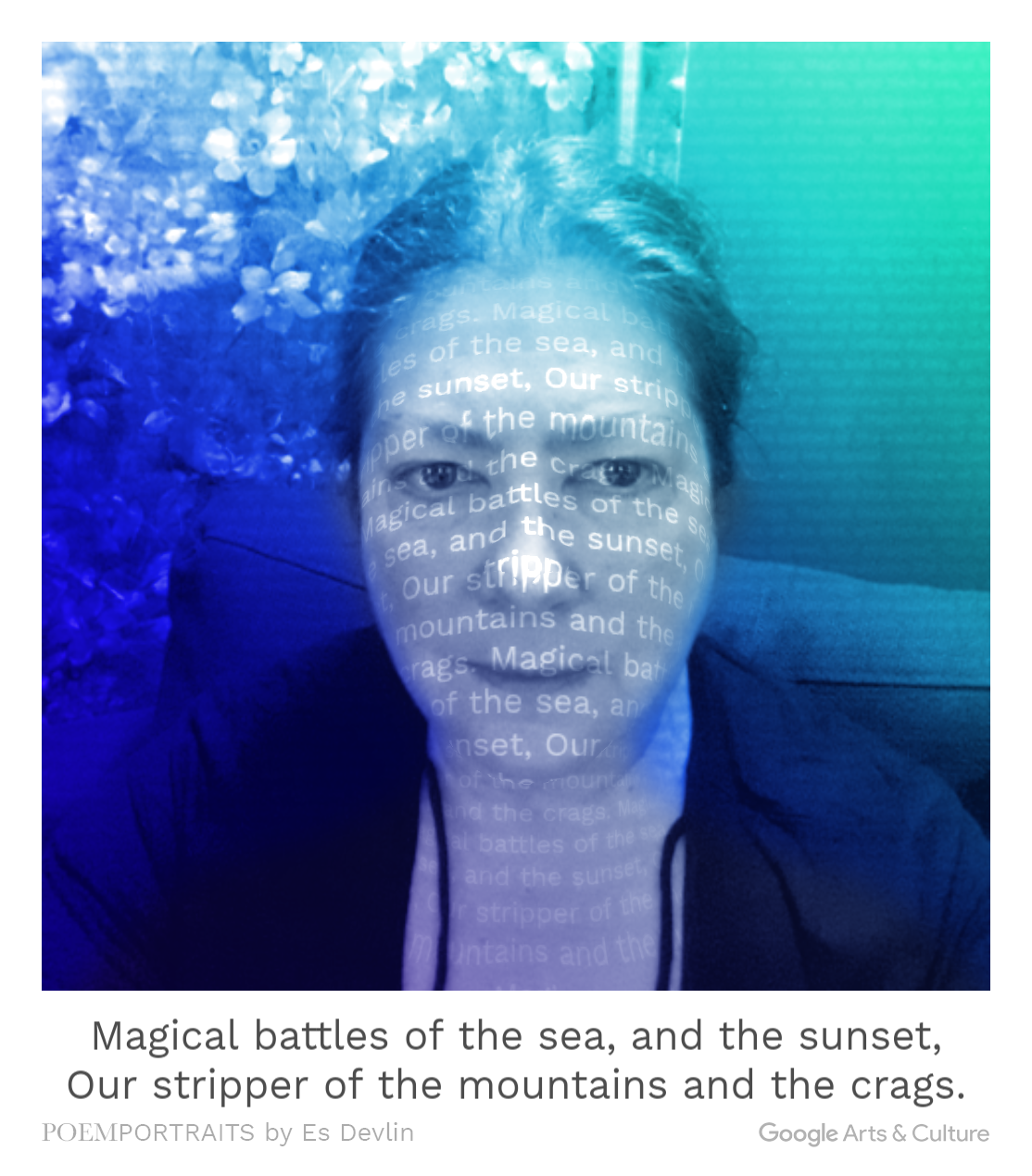
In the meantime, I’d like to share this link that showed up on my Facebook feed from one of my poetry friends. It’s called Poem Portraits, the brainchild of Es Devlin. It’s an online experiment combining artificial intelligence and human intelligence to create a collective poem. To participate, you go to the website and add a word. Simple as that. Then you have the option of allowing the site access to your camera so it can create your “Word Portrait.”
The word (one of many, I might add) I chose was magical. I never use the camera on my lap top so the program couldn’t access it, so the picture at the top of this post is what you get without access. But then I had the bright idea of accessing the site with my phone. Using the same word I got the picture below as the result (and yes, I know, I take terrible selfies!).
I don’t know why my phone turned the picture blue for the selfie. A couple of other tries I made (that were even worse that this one) were yellow and pink . . . Maybe the camera in my phone was just getting tired. LOL
If you want to give it a try, the website is HERE . Go ahead, give it a shot. All it takes is one word.
Prompts of the Week
Prompt One
You have discovered what appears to be an ordinary room. But as soon as you enter the room, time stops for you. When you leave the room, time picks up right where you left off. What do you use this room for?
Prompt Two
Write a story that begins with the title of the book you’ve most recently read and ends with the name of your favourite character that you’ve written.
You don’t need to spend a lot of time on these, they’re just meant for fun. Take 5 minutes to think about it, then write for 10 or 15 minutes. And if it turns out you like what you’ve written, then by all means turn your exercise into an actual story. You can find these prompts, and others like them, at Writer's Digest .
Wednesday, August 29, 2018
John Keats
I think the most surprising thing about Keats, to me at least, is that his poetry career only lasted three and a half years. He wrote more than 150 poems in that short time – just think what he might have accomplished had he lived!
His parents died when he was 15 and the following year he was apprenticed to an apothecary-surgeon. Keats found the medical profession not to be his liking and published his first volume of poetry in 1817. The following year wrote and published Endymion, which was based on the Greek myth of the shepherd beloved by the moon. His final volume of work was published in 1820, and he died of tuberculosis early in the following year.
There are actually two versions of the poem I’ve chosen for today. The first was penned by Keats in 1819, and the second was the published in 1820 and it’s somewhat of a mystery as to who changed it or why. But never fear, I’m only going to include one version here.
A couple of things worth noting, La Belle Dame Sans Merci translates to beautiful lady without mercy and the original version was included in a letter to Keats’ brother George. Also, the famous pre-Raphaelite artist John William Waterhouse was inspired by the poem to create one of his most famous works.
Original version of La Belle Dame Sans Merci, 1819
Oh what can ail thee, knight-at-arms,
Alone and palely loitering?
The sedge has withered from the lake,
And no birds sing.
Oh what can ail thee, knight-at-arms,
So haggard and so woe-begone?
The squirrel’s granary is full,
And the harvest’s done.
I see a lily on thy brow,
With anguish moist and fever-dew,
And on thy cheeks a fading rose
Fast withereth too.
I met a lady in the meads,
Full beautiful – a faery’s child,
Her hair was long, her foot was light,
And her eyes were wild.
I made a garland for her head,
And bracelets too, and fragrant zone;
She looked at me as she did love,
And made sweet moan.
I set her on my pacing steed,
And nothing else saw all day long,
For sidelong would she bend, and sing
A faery’s song.
She found me roots of relish sweet,
And honey wild, and manna-dew,
And sure in language strange she said –
‘I love thee true’.
She took me to her elfin grot,
And there she wept and sighed full sore,
And there I shut her wild wild eyes
With kisses four.
And there she lulled me asleep
And there I dreamed – Ah! woe betide! –
The latest dream I ever dreamt
On the cold hill side.
I saw pale kings and princes too,
Pale warriors, death-pale were they all;
They cried – ‘La Belle Dame sans Merci
Hath thee in thrall!’
I saw their starved lips in the gloam,
With horrid warning gaped wide,
And I awoke and found me here,
On the cold hill’s side.
And this is why I sojourn here
Alone and palely loitering,
Though the sedge is withered from the lake,
And no birds sing.
His parents died when he was 15 and the following year he was apprenticed to an apothecary-surgeon. Keats found the medical profession not to be his liking and published his first volume of poetry in 1817. The following year wrote and published Endymion, which was based on the Greek myth of the shepherd beloved by the moon. His final volume of work was published in 1820, and he died of tuberculosis early in the following year.
There are actually two versions of the poem I’ve chosen for today. The first was penned by Keats in 1819, and the second was the published in 1820 and it’s somewhat of a mystery as to who changed it or why. But never fear, I’m only going to include one version here.
A couple of things worth noting, La Belle Dame Sans Merci translates to beautiful lady without mercy and the original version was included in a letter to Keats’ brother George. Also, the famous pre-Raphaelite artist John William Waterhouse was inspired by the poem to create one of his most famous works.
Original version of La Belle Dame Sans Merci, 1819
Oh what can ail thee, knight-at-arms,
Alone and palely loitering?
The sedge has withered from the lake,
And no birds sing.
Oh what can ail thee, knight-at-arms,
So haggard and so woe-begone?
The squirrel’s granary is full,
And the harvest’s done.
I see a lily on thy brow,
With anguish moist and fever-dew,
And on thy cheeks a fading rose
Fast withereth too.
I met a lady in the meads,
Full beautiful – a faery’s child,
Her hair was long, her foot was light,
And her eyes were wild.
I made a garland for her head,
And bracelets too, and fragrant zone;
She looked at me as she did love,
And made sweet moan.
I set her on my pacing steed,
And nothing else saw all day long,
For sidelong would she bend, and sing
A faery’s song.
She found me roots of relish sweet,
And honey wild, and manna-dew,
And sure in language strange she said –
‘I love thee true’.
She took me to her elfin grot,
And there she wept and sighed full sore,
And there I shut her wild wild eyes
With kisses four.
And there she lulled me asleep
And there I dreamed – Ah! woe betide! –
The latest dream I ever dreamt
On the cold hill side.
I saw pale kings and princes too,
Pale warriors, death-pale were they all;
They cried – ‘La Belle Dame sans Merci
Hath thee in thrall!’
I saw their starved lips in the gloam,
With horrid warning gaped wide,
And I awoke and found me here,
On the cold hill’s side.
And this is why I sojourn here
Alone and palely loitering,
Though the sedge is withered from the lake,
And no birds sing.
Wednesday, August 16, 2017
Twofer
I’ve been in a bit of a dry spell writing wise lately, even when it comes to poetry. So once again I’m digging in the vaults for my post. Good thing I’ve got a lot of poems to choose from, eh? And because today’s poems are a little on the short side, you’re getting a two for one special.
You’re welcome. LOL
This first poem was part of the Writer’s Digest PAD challenge I partook of several years ago. The idea was to write a poem a day, to their prompts, over the month of April. If nothing else, the challenge was interesting, and it introduced me to the Sestina, which set me on an exploration of other forms.
I believe the prompt I had to follow for this one was something to do with being dead, or things you'd like to say to people after you're dead, or something along those lines.
Now That I’m Dead
Now that I’m dead I can finally say
all the things burning inside me.
None to prevent me having my way,
to speak serious or blithely.
I can speak of my love without any fear
of derision of my choices.
I can speak all the words you never could hear
in a chorus of many voices.
Did you think with me gone my words would be too?
You don’t really have to answer.
Words, like money, often accrue.
My words will be here forever.
* ~ * ~ * ~ *
For my second poem I thought I’d lighten things up a bit. This poem is a parody. It may surprise you to learn, considering most of my poetry is rather dark, that I love parodies. I love taking a classic poem, twisting it around, and making someone chuckle over the results.
Unless you slept through English class, you should recognize what poem I used for this particular parody. For those of you who did sleep through English class, the original poem was Elizabeth Barrett Browning’s immortal How Do I Love thee. If you’d like to read the original, check this out. And now, my version:
How Do I Procrastinate?
How do I procrastinate? Let me count the ways.
I procrastinate to the depth and breadth and height
My soul can reach, when feeling lethargic
For the ends of Boredom and ideal Laziness.
I procrastinate to the level of everyday’s
Most quiet need, by neon and halogen-light.
I procrastinate freely, as men strive for Progress;
I procrastinate purely, as they turn from Television.
I procrastinate with a passion put to use
In my old excuses, and with my childhood’s justification.
I procrastinate with an energy I seemed to lose
When faced with work, – I procrastinate with the breath,
Smiles, tears, of all my life! – and, if the Muse choose,
I shall continue to procrastinate until death.
You’re welcome. LOL
This first poem was part of the Writer’s Digest PAD challenge I partook of several years ago. The idea was to write a poem a day, to their prompts, over the month of April. If nothing else, the challenge was interesting, and it introduced me to the Sestina, which set me on an exploration of other forms.
I believe the prompt I had to follow for this one was something to do with being dead, or things you'd like to say to people after you're dead, or something along those lines.
Now That I’m Dead
Now that I’m dead I can finally say
all the things burning inside me.
None to prevent me having my way,
to speak serious or blithely.
I can speak of my love without any fear
of derision of my choices.
I can speak all the words you never could hear
in a chorus of many voices.
Did you think with me gone my words would be too?
You don’t really have to answer.
Words, like money, often accrue.
My words will be here forever.
* ~ * ~ * ~ *
For my second poem I thought I’d lighten things up a bit. This poem is a parody. It may surprise you to learn, considering most of my poetry is rather dark, that I love parodies. I love taking a classic poem, twisting it around, and making someone chuckle over the results.
Unless you slept through English class, you should recognize what poem I used for this particular parody. For those of you who did sleep through English class, the original poem was Elizabeth Barrett Browning’s immortal How Do I Love thee. If you’d like to read the original, check this out. And now, my version:
How Do I Procrastinate?
How do I procrastinate? Let me count the ways.
I procrastinate to the depth and breadth and height
My soul can reach, when feeling lethargic
For the ends of Boredom and ideal Laziness.
I procrastinate to the level of everyday’s
Most quiet need, by neon and halogen-light.
I procrastinate freely, as men strive for Progress;
I procrastinate purely, as they turn from Television.
I procrastinate with a passion put to use
In my old excuses, and with my childhood’s justification.
I procrastinate with an energy I seemed to lose
When faced with work, – I procrastinate with the breath,
Smiles, tears, of all my life! – and, if the Muse choose,
I shall continue to procrastinate until death.
Wednesday, August 9, 2017
Last Dragonflight
This poem is an oldie but a goodie. In fact it’s one of my earliest poems, probably inspired by Anne McCaffrey’s Pern novels. I wrote it for no particular reason other than the desire to write a poem that told a story.
Last Dragonflight
Slowly dawns the red sun
To mark a dragon’s birth -
Once master of the heavens,
Now master of the Earth
You found your beginning
In smoke, ash and flame -
Creature born of legend
Like the phoenix rise again.
Awake unfurl your wings,
Your time has come this night
Uncoil, cry out your challenge,
Then launch, at last take flight.
Wheeling silent skyward
Exhaling smoke and fire
Phosphor rains but still you’re
Soaring ever higher.
Silence marks your passing,
Envious eyes will stare.
Man would subjugate you
Creature of the air.
Cloaked in rage and silence
They’ve watched you on your flight
Blind with superstition.
Against your will you fight.
Belief dies too easily;
Myths vanish without care.
Rear up once in protest -
Death’s not always fair.
Slowly dies the red sun -
The dragon seeks his den.
Slowly dies the legend
Never to rise again.
Slowly dawns the red sun
To mark a dragon’s birth -
Once master of the heavens,
Now master of the Earth
You found your beginning
In smoke, ash and flame -
Creature born of legend
Like the phoenix rise again.
Awake unfurl your wings,
Your time has come this night
Uncoil, cry out your challenge,
Then launch, at last take flight.
Wheeling silent skyward
Exhaling smoke and fire
Phosphor rains but still you’re
Soaring ever higher.
Silence marks your passing,
Envious eyes will stare.
Man would subjugate you
Creature of the air.
Cloaked in rage and silence
They’ve watched you on your flight
Blind with superstition.
Against your will you fight.
Belief dies too easily;
Myths vanish without care.
Rear up once in protest -
Death’s not always fair.
Slowly dies the red sun -
The dragon seeks his den.
Slowly dies the legend
Never to rise again.
Wednesday, July 26, 2017
Shepherds and Nymphs
If you take a look at some of my favourite poems written by other people, it’s easy to see how I ended up with such a strong sense of rhyme and rhythm. I cut my poetry teeth on the classics. To be honest, while most kids in my English classes struggled to understand classic poetry, I struggled to understand modern poetry.
This week I’d like to share one of my very first favourite poems. I love the rhyme and rhythm of it, as well as the story it tells.
The Passionate Shepherd to His Love
Come live with me and be my love,
And we will all the pleasures prove
That valleys, groves, hills, and fields,
Woods, or steepy mountain yields.
And we will sit upon rocks,
Seeing the shepherds feed their flocks,
By shallow rivers to whose falls
Melodious birds sing madrigals.
And I will make thee beds of roses
And a thousand fragrant poises,
A cap of flowers, and a kirtle
Embroidered all with leaves of myrtle;
A gown made of the finest wool
Which from our pretty lambs we pull;
Fair lined slippers for the cold,
With buckles of the purest gold;
A belt of straw and ivy buds,
With coral clasps and amber studs;
And if these pleasures may thee move,
Come live with me, and be my love.
The shepherd's swains shall dance and sing
For thy delight each May morning:
If these delights thy mind may move,
Then live with me and be my love.
~ Christopher Marlowe
1599
And of course what would the shepherd’s plea be without his lady love’s reply?
The Nymph's Reply to the Shepherd
If all the world and love were young,
And truth in every shepherd's tongue,
These pretty pleasures might me move
To live with thee and be thy love.
Time drives the flocks from field to fold,
When rivers rage and rocks grow cold;
And Philomel becometh dumb;
The rest complain of cares to come.
The flowers do fade, and wanton fields
To wayward winter reckoning yields;
A honey tongue, a heart of gall,
Is fancy's spring, but sorrow's fall.
Thy gowns, thy shoes, thy bed of roses,
Thy cap, thy kirtle, and thy posies,
Soon break, soon wither, soon forgotten,
In folly ripe, in reason rotten.
Thy belt of straw and ivy buds,
Thy coral clasps and amber studs,
All these in me no means can move
To come to thee and be thy love.
But could youth last and love still breed,
Had joys no date nor age no need,
Then these delights my mind might move
To live with thee and be thy love.
~ Sir Walter Raleigh
1600
This week I’d like to share one of my very first favourite poems. I love the rhyme and rhythm of it, as well as the story it tells.
The Passionate Shepherd to His Love
Come live with me and be my love,
And we will all the pleasures prove
That valleys, groves, hills, and fields,
Woods, or steepy mountain yields.
And we will sit upon rocks,
Seeing the shepherds feed their flocks,
By shallow rivers to whose falls
Melodious birds sing madrigals.
And I will make thee beds of roses
And a thousand fragrant poises,
A cap of flowers, and a kirtle
Embroidered all with leaves of myrtle;
A gown made of the finest wool
Which from our pretty lambs we pull;
Fair lined slippers for the cold,
With buckles of the purest gold;
A belt of straw and ivy buds,
With coral clasps and amber studs;
And if these pleasures may thee move,
Come live with me, and be my love.
The shepherd's swains shall dance and sing
For thy delight each May morning:
If these delights thy mind may move,
Then live with me and be my love.
~ Christopher Marlowe
1599
And of course what would the shepherd’s plea be without his lady love’s reply?
The Nymph's Reply to the Shepherd
If all the world and love were young,
And truth in every shepherd's tongue,
These pretty pleasures might me move
To live with thee and be thy love.
Time drives the flocks from field to fold,
When rivers rage and rocks grow cold;
And Philomel becometh dumb;
The rest complain of cares to come.
The flowers do fade, and wanton fields
To wayward winter reckoning yields;
A honey tongue, a heart of gall,
Is fancy's spring, but sorrow's fall.
Thy gowns, thy shoes, thy bed of roses,
Thy cap, thy kirtle, and thy posies,
Soon break, soon wither, soon forgotten,
In folly ripe, in reason rotten.
Thy belt of straw and ivy buds,
Thy coral clasps and amber studs,
All these in me no means can move
To come to thee and be thy love.
But could youth last and love still breed,
Had joys no date nor age no need,
Then these delights my mind might move
To live with thee and be thy love.
~ Sir Walter Raleigh
1600
Wednesday, July 19, 2017
Bingo Blues
One of my jobs when I worked in the Municipal Office of our town (many years ago) was to record the bingo results from the weekend games. I was pretty surprised by the number of charities that ran bingos to raise funds. And even more surprising was how little they actually made from it.
But bingo was big business in our town, especially with the seniors. I can’t remember exactly when I visited one of the bingo halls one night - taking a message to someone, picking someone up, I have no idea. I know I wasn’t there long and I wasn’t there to play. The one thing I do remember is walking into the pervading cloud of smoke.
It was shortly after that that legislation was passed banning smoking in public places. It caused a pretty big stir at the time, but despite the artistic license in my poem, nothing stops a die-hard bingo player.
Bingo Blues
The room’s filled with fog
From the chain smoking grannies
Don’t mess with their luck
Or you’ll find yourself
Out on your ear
The concentration is fierce
Daubers flying furiously
Hearing aides at the max
Canes within reach
To snag a new card
It’s Saturday night
At the Bingo Hall
Truck on over
And don’t forget
Your pension cheque.
Then the hammer falls
In the form of a by-law
Banning the cancer sticks
Causing an uprising
Of the blue hair set.
Now it’s Saturday night
And they meet at Timmie’s
Walkers parked outside
While they reminisce
Over a cup of joe.
But bingo was big business in our town, especially with the seniors. I can’t remember exactly when I visited one of the bingo halls one night - taking a message to someone, picking someone up, I have no idea. I know I wasn’t there long and I wasn’t there to play. The one thing I do remember is walking into the pervading cloud of smoke.
It was shortly after that that legislation was passed banning smoking in public places. It caused a pretty big stir at the time, but despite the artistic license in my poem, nothing stops a die-hard bingo player.
Bingo Blues
The room’s filled with fog
From the chain smoking grannies
Don’t mess with their luck
Or you’ll find yourself
Out on your ear
The concentration is fierce
Daubers flying furiously
Hearing aides at the max
Canes within reach
To snag a new card
It’s Saturday night
At the Bingo Hall
Truck on over
And don’t forget
Your pension cheque.
Then the hammer falls
In the form of a by-law
Banning the cancer sticks
Causing an uprising
Of the blue hair set.
Now it’s Saturday night
And they meet at Timmie’s
Walkers parked outside
While they reminisce
Over a cup of joe.
Wednesday, July 12, 2017
Caffeinated Dreams
This is a fairly new poem, written just a few weeks ago. I got the idea for it while, you guessed it, sitting on the pier sipping an iced coffee with a friend. The car was facing towards the beach and I made a comment about how nice it would be to sit under one of those trees to write.
The reality is that it wouldn’t be that all that conducive to writing. It was a weekend and there were hoards of screaming kids everywhere. Plus I’d probably do more people watching and looking at the scenery than actual writing.
But I came home and wrote the following poem:
Caffeinated Dreams
I sit on the pier
sipping my iced coffee
and I have a vision:
I sit in the park
under a tree
back against the rough bark
big floppy hat on my head
doodling, scribbling, writing in
a notebook propped up on my knees
words spilling over
right off of the page
racing away
with a shout of laughter
but I am unaware
that my story is escaping
and I keep writing
until it’s too dark
to see.
Anchored in reality
I take the last sip of my coffee
and with a wistful sigh
go home.
The reality is that it wouldn’t be that all that conducive to writing. It was a weekend and there were hoards of screaming kids everywhere. Plus I’d probably do more people watching and looking at the scenery than actual writing.
But I came home and wrote the following poem:
Caffeinated Dreams
I sit on the pier
sipping my iced coffee
and I have a vision:
I sit in the park
under a tree
back against the rough bark
big floppy hat on my head
doodling, scribbling, writing in
a notebook propped up on my knees
words spilling over
right off of the page
racing away
with a shout of laughter
but I am unaware
that my story is escaping
and I keep writing
until it’s too dark
to see.
Anchored in reality
I take the last sip of my coffee
and with a wistful sigh
go home.
Wednesday, July 5, 2017
Paradelle
This being the first Wednesday of the month, it’s time for a form!
After much consideration, I chose the Paradelle. This form was invented by Billy Collins (who was the U.S. Poet Laureate at the time) as a parody of the Villanelle. He did it as a joke, claiming it was one of the more demanding French forms. The joke was on him when people took him seriously and began writing their own Paradelles.
This form has four stanzas with six lines each. The first three stanzas have the following format: lines 1 and 2 are the same; lines 3 and 4 are the same; but lines 5 and 6 must contain all the words from the previous lines, using each word only once. And just to make things interesting, the fourth stanza uses all of the words from the previous stanzas, and again uses each word only once. Got that now?
You’d think with all that repetition this would be an easy form, but it’s not. The last two lines of each stanza were bad, but nothing compared to the final stanza. Trying to fit all the words from the previous stanza without leaving any of them out is pretty tricky. If anyone out there would like a poetry challenge, I highly recommend the Paradelle.
And I unashamedly admit that I did not create a new poem as an example, this is the one from my original poetry post.
Vampire Moon
Red moon in the sky, swollen and full
Bathing the world in its ghostly light
Swollen in red, the full ghostly world
Bathing the moon and sky in its light
The time has come to embrace the night
Rise, take your place in the mortal realm
Take your place in the night rise, mortal.
Embrace the realm, the time has come to.
Soft velvet night of the vampire moon
Awaits you with your heart’s desire
Velvet vampire desire. Soft night,
Your heart’s moon awaits with you.
In your sky, has the velvet moon come?
The night awaits with your place in
the world, swollen and full of the light.
You, bathing in its soft ghostly night.
Rise, heart’s desire, take the mortal realm;
Time to embrace the red vampire moon.
If you’d like to learn more about the Paradelle, and maybe even try one for yourself, check out one of the following links:
Shadow Poetry - Paradelle
Writer's Digest - Poetic Asides
Poets Online Archive
After much consideration, I chose the Paradelle. This form was invented by Billy Collins (who was the U.S. Poet Laureate at the time) as a parody of the Villanelle. He did it as a joke, claiming it was one of the more demanding French forms. The joke was on him when people took him seriously and began writing their own Paradelles.
This form has four stanzas with six lines each. The first three stanzas have the following format: lines 1 and 2 are the same; lines 3 and 4 are the same; but lines 5 and 6 must contain all the words from the previous lines, using each word only once. And just to make things interesting, the fourth stanza uses all of the words from the previous stanzas, and again uses each word only once. Got that now?
You’d think with all that repetition this would be an easy form, but it’s not. The last two lines of each stanza were bad, but nothing compared to the final stanza. Trying to fit all the words from the previous stanza without leaving any of them out is pretty tricky. If anyone out there would like a poetry challenge, I highly recommend the Paradelle.
And I unashamedly admit that I did not create a new poem as an example, this is the one from my original poetry post.
Vampire Moon
Red moon in the sky, swollen and full
Bathing the world in its ghostly light
Swollen in red, the full ghostly world
Bathing the moon and sky in its light
The time has come to embrace the night
Rise, take your place in the mortal realm
Take your place in the night rise, mortal.
Embrace the realm, the time has come to.
Soft velvet night of the vampire moon
Awaits you with your heart’s desire
Velvet vampire desire. Soft night,
Your heart’s moon awaits with you.
In your sky, has the velvet moon come?
The night awaits with your place in
the world, swollen and full of the light.
You, bathing in its soft ghostly night.
Rise, heart’s desire, take the mortal realm;
Time to embrace the red vampire moon.
If you’d like to learn more about the Paradelle, and maybe even try one for yourself, check out one of the following links:
Shadow Poetry - Paradelle
Writer's Digest - Poetic Asides
Poets Online Archive
Wednesday, June 14, 2017
Words
Do you remember, back in your high school English class, having to dissect a poem? Your teacher would pick something by Keats or Wordsworth or Longfellow and tell you to write 500 or 1000 words on what the author really meant when he wrote that poem. I don’t know why they do that. No one really knows what the author means except the author themselves. And most of the poets that are studied in school have been dead for a long time.
The poem I’m featuring today was one I wrote in high school. Because I wrote it a few weeks after I broke up with my first boyfriend, everyone assumed I wrote it for him. I even had a couple of his friends come up to me and tell me to leave him alone, he’d moved on. But the truth is, I didn’t write it for anyone. It’s just a poem about words - there’s no hidden meaning. I got to thinking about words and how they can mean something different from what you intended. And then I kind of segued into story mode just to make it longer.
Anyway, here it is in all its glory. :-D
WORDS
Words to share with lovers
their meanings old as time,
and words I never said to you,
I thought them only mine;
words that can work magic,
that mend a broken heart;
words that seem to give you
another brand new start.
I wish that I had told you
the words I had in mind.
It might have made a difference
if we were given time.
The world's a mess because of words
that no-one thought to say,
and now I think that it's too late,
those words are here to stay.
I wish that we could build new words,
their meanings deep and true,
and I would take back words I said
and change them just for you.
You do not understand my words,
you never did it seems,
for words have double meanings
and I was filled with dreams;
I spoke too fast, I wasn't sure
of words I could not say,
and so I kept them deep inside
and now they're there to stay.
If I thought words could bring you back
I'd chatter day and night,
but it's too late for both of us
to make the wrong words right.
The poem I’m featuring today was one I wrote in high school. Because I wrote it a few weeks after I broke up with my first boyfriend, everyone assumed I wrote it for him. I even had a couple of his friends come up to me and tell me to leave him alone, he’d moved on. But the truth is, I didn’t write it for anyone. It’s just a poem about words - there’s no hidden meaning. I got to thinking about words and how they can mean something different from what you intended. And then I kind of segued into story mode just to make it longer.
Anyway, here it is in all its glory. :-D
WORDS
Words to share with lovers
their meanings old as time,
and words I never said to you,
I thought them only mine;
words that can work magic,
that mend a broken heart;
words that seem to give you
another brand new start.
I wish that I had told you
the words I had in mind.
It might have made a difference
if we were given time.
The world's a mess because of words
that no-one thought to say,
and now I think that it's too late,
those words are here to stay.
I wish that we could build new words,
their meanings deep and true,
and I would take back words I said
and change them just for you.
You do not understand my words,
you never did it seems,
for words have double meanings
and I was filled with dreams;
I spoke too fast, I wasn't sure
of words I could not say,
and so I kept them deep inside
and now they're there to stay.
If I thought words could bring you back
I'd chatter day and night,
but it's too late for both of us
to make the wrong words right.
Wednesday, June 7, 2017
Poetry Anyone?
Once upon a time I participated in something called the PAD challenge run by Writer’s Digest. It was held during the month of April, National Poetry Month, and the idea was to write a Poem A Day using the prompts they’d supply. One of these prompts was for something called a sestina. With all the poetry I’ve written over the years, I’d never heard of a sestina before. It was a little challenging, and by the time I was done I was starting to wonder how many other poetry forms were there out there that I’d never heard of.
Turns out there were a lot!
For the next couple of years I had a separate blog for poetry and I’d share a new form with an original example each week. Sometimes I’d feature other poems, but mostly it was all about the forms. Then some person I’d never heard of sent me an email accusing me of using her information (not her poems) without citing her as a source.
So I dutifully went back through my posts and found two instances where the information was similar - not the same, just similar - to what she had on her site. I’m actually surprised there weren’t more. Although I used a variety of sources, sometimes there are only so many ways you can say: This is a Japanese form and the syllable count is...
Anyway, I reworded my posts and thought no more about it until I got an email from a gentleman with a similar complaint. Really? I checked, and once again the words were not an exact match but pretty similar. On a whim I checked the woman’s site and oh, gee, look at that. His words were an exact match to hers.
That was it for me. I was done. I’d started the blog to share my love of poetry, not to be harassed by small-minded, mean-spirited people. At this point I’d explored over a hundred different forms, but the whole thing left a sour taste in my mouth so I pulled the blog.
For the next few years I only wrote poetry occasionally, and didn’t share any of it. Then I shared a couple of special occasion poems. Then Jamie and I did a PAD challenge of our own and it kind of revived my interest again. And now, here we are.
As a new feature on this blog, I’ve decided that Wednesday is going to be poetry day. The first Wednesday of the month (which would be today) I’m going to share a form. The rest of the Wednesdays will be just random poems - some new, some old, maybe even some old favorites culled from my library of really old poetry books.
I’m not going to go into a lot of detail about the forms, for obvious reasons, but I will include links should you care to explore them yourself. So ... I’m going to begin where I began in the beginning, with the sestina.
The sestina was one of the most challenging forms I’ve ever encountered. It has 39 lines in total, divided into six verses of six lines each, and a three line envoi at the end. Sounds easy enough, right? Especially since it doesn’t have to rhyme. But here’s the thing. You start off by coming up with six words, and each of these words is used as a end word of one line in each of the six verses and the order changes in each verse.
For my sestina, I used the words: truth, grave, life, night, death, and stone.
Night Dweller’s Truth
In every breath there is a truth
that overshadows every grave,
a truth not found within a life
that shines its beacon into night,
a knowledge brought about by death
and graven into hardest stone.
A thought that’s carved in precious stone
contains what we perceive as truth,
unsuppressed by certain death,
as cold and alien as the grave,
deep and dark as empty night
just before it bursts to life.
If I’d but know how sweet is life,
not just a pathway strewn with stone,
perhaps I’d not embraced the night
that fills me with its awful truth
and takes me far beyond the grave
out of reach of even death.
And what is that which we call death?
Perhaps another way of life,
the end is more than just the grave,
a fresh turned mound that’s capped with stone.
Perhaps we’ll never know the truth
before we pass into the night.
Come and share this sweetest night
where we can stand abreast of death,
and we will seek the perfect truth
of what is that which we call life
that gathers round us like a stone
and leads us blindly to the grave.
You look at me with visage grave -
accept my words, accept the night,
accept that fate’s not carved in stone.
Turn away from Lady Death,
her promise of the afterlife,
and know what’s in my heart is truth.
We’ll find our truth without the grave
and make our life within the night,
then vanquish death with shattered stone.
If you’d like to learn more or better yet, try your hand at your own sestina, here are a couple of sites that I’ve found helpful in the past:
Baymoon
The Poetry Foundation
Shmoop
Turns out there were a lot!
For the next couple of years I had a separate blog for poetry and I’d share a new form with an original example each week. Sometimes I’d feature other poems, but mostly it was all about the forms. Then some person I’d never heard of sent me an email accusing me of using her information (not her poems) without citing her as a source.
So I dutifully went back through my posts and found two instances where the information was similar - not the same, just similar - to what she had on her site. I’m actually surprised there weren’t more. Although I used a variety of sources, sometimes there are only so many ways you can say: This is a Japanese form and the syllable count is...
Anyway, I reworded my posts and thought no more about it until I got an email from a gentleman with a similar complaint. Really? I checked, and once again the words were not an exact match but pretty similar. On a whim I checked the woman’s site and oh, gee, look at that. His words were an exact match to hers.
That was it for me. I was done. I’d started the blog to share my love of poetry, not to be harassed by small-minded, mean-spirited people. At this point I’d explored over a hundred different forms, but the whole thing left a sour taste in my mouth so I pulled the blog.
For the next few years I only wrote poetry occasionally, and didn’t share any of it. Then I shared a couple of special occasion poems. Then Jamie and I did a PAD challenge of our own and it kind of revived my interest again. And now, here we are.
As a new feature on this blog, I’ve decided that Wednesday is going to be poetry day. The first Wednesday of the month (which would be today) I’m going to share a form. The rest of the Wednesdays will be just random poems - some new, some old, maybe even some old favorites culled from my library of really old poetry books.
I’m not going to go into a lot of detail about the forms, for obvious reasons, but I will include links should you care to explore them yourself. So ... I’m going to begin where I began in the beginning, with the sestina.
The sestina was one of the most challenging forms I’ve ever encountered. It has 39 lines in total, divided into six verses of six lines each, and a three line envoi at the end. Sounds easy enough, right? Especially since it doesn’t have to rhyme. But here’s the thing. You start off by coming up with six words, and each of these words is used as a end word of one line in each of the six verses and the order changes in each verse.
For my sestina, I used the words: truth, grave, life, night, death, and stone.
Night Dweller’s Truth
In every breath there is a truth
that overshadows every grave,
a truth not found within a life
that shines its beacon into night,
a knowledge brought about by death
and graven into hardest stone.
A thought that’s carved in precious stone
contains what we perceive as truth,
unsuppressed by certain death,
as cold and alien as the grave,
deep and dark as empty night
just before it bursts to life.
If I’d but know how sweet is life,
not just a pathway strewn with stone,
perhaps I’d not embraced the night
that fills me with its awful truth
and takes me far beyond the grave
out of reach of even death.
And what is that which we call death?
Perhaps another way of life,
the end is more than just the grave,
a fresh turned mound that’s capped with stone.
Perhaps we’ll never know the truth
before we pass into the night.
Come and share this sweetest night
where we can stand abreast of death,
and we will seek the perfect truth
of what is that which we call life
that gathers round us like a stone
and leads us blindly to the grave.
You look at me with visage grave -
accept my words, accept the night,
accept that fate’s not carved in stone.
Turn away from Lady Death,
her promise of the afterlife,
and know what’s in my heart is truth.
We’ll find our truth without the grave
and make our life within the night,
then vanquish death with shattered stone.
If you’d like to learn more or better yet, try your hand at your own sestina, here are a couple of sites that I’ve found helpful in the past:
Baymoon
The Poetry Foundation
Shmoop
Saturday, April 22, 2017
Week Three of the Jamie and Carol Poetry Challenge
Whoops! I almost forgot. It’s Saturday, and that means it’s time to post my week’s worth of poems. In case you missed the previous posts, you can find Week One HERE and Week Two HERE. And don’t forget to check out Jamie’s poems HERE.
Without further ado, POEMS!
Poem #15
The Monotetra can have any number of stanzas of four lines each, but must have at least two. Each stanza contains a mono-rhyme, so that the pattern is aaaa, bbbb, cccc, and so on, and eight syllables, and the last line of each stanza has a repeating four-syllable phrase, like an echo, to make it look like a refrain.
The Price to Pay
The wind is from the west today
I stand and watch the branches sway
a storm is coming, so they say -
perhaps it may, perhaps it may.
But wind and rain are not what wait
for one like me, no it is fate
upon my soul it’s hunger sate
so filled with hate, so filled with hate.
I dabbled in what I should not
never thinking I’d be caught -
it’s not as if I’d not been taught
but I forgot, but I forgot.
There always is a price to pay
for those who once were made of clay
but changed to stop life’s slow decay
to my dismay, to my dismay.
I come to you, confess my sin
remind you all of what has been
the world around me starts to spin
please let me in, please let me in.
It doesn’t matter anyhow
alas there is no succor now
for those who broke a sacred vow
the end is now, the end is now.
Poem #16
You know, you’d think Sunday’s poem would be easier because I’m not following a specific form, but I still have to come up with a subject, and my brain feels like it’s full of sawdust.
I Make The Plans
I make the plans and then I watch
as plans go all awry
all that time gone with a splotch
and all I can do is sigh.
I make the plans and then I see
other things to do
I go upon a cleaning spree
and then I sit and stew.
I make the plans and then I find
a web cam on the ‘net
I watch the feed ‘til I’m near blind
and so the pattern’s set.
I make the plans but never seem
to stick to them, I guess
plans for me are just a dream -
they only cause me stress.
Poem #17
Naani is one of India's most popular Telugu forms. The name means “an expression of one and all”. It consists of four lines, with a total of 20 to 25 syllables. The Naani has no rhyme scheme and there is no set length to each line, nor is the poem is not bound to a particular subject. My kind of poem! It was so much fun I did three of them. :-)
I offer you a cup of words
take what you want -
the rest will fly free
like dandelion seeds on the wind.
Look up, look up
into a clear blue sky
where thoughts and dreams drift
in the shape of white clouds.
Ink spills across the page
needing the mind’s eye
to decipher the meaning
of the poet’s thoughts.
Poem #18
The Ochtfochlach (points if you can pronounce it) is from Ireland. It has 8 lines, any consistent number of syllables, and the rhyme scheme is AAAB CCCB.
Split
There is a darkness deep in me
Down where no one else can see
Filled with all of life’s debris
and what I perceive is pay back.
Sometimes I let the darkness out
but only when no one’s about
and then true evil starts to sprout
and there’s no turning back.
Poem #19
The Pensee is a syllabic form with five lines. The structure is as follows:
Line 1: subject – 2 syllables
Line 2: description – 4 syllables Line 3: action – 7 syllables
Line 4: setting – 8 syllables
Line 5: final thought – 6 syllables
Titles are optional, but I titled mine and did two of them because they’re short.
Magic
faeries
in the moonlight
flittering and dancing free
in the hidden magic forest
make me feel young again.
Depression
journey
into darkness
the black dog is chasing you
to the edge of the mind’s abyss
the dark night of the soul.
Poem #20
I had a lot of choices for the letter Q and in the end I chose my two favorites.
A quinzaine is an unrhymed verse of fifteen syllables. These syllables are distributed as follows:
Line 1: Statement of 7 syllables
Line 2: Beginning of question with 5 syllables
Line 3: End of question with 3 syllables
I always expect the worst -
why do I do that?
I don’t know.
The flapping of wings fills the air.
Where do ducks come from?
Will they stay?
* ~ * ~ * ~ * ~ *
A Quatern is a sixteen line French form. Rhymes are not a requirement and if one is used the rhyme scheme or rhyming pattern is entirely up to the poet. The Quatern:
1) Must have four verses.
2) Each verse must have four lines.
3) Each line must have eight syllables.
4) It must have a first line which is a descending repeated line.
Magic Rare
A quality of magic rare
dwells within the most worthy souls;
a hidden essence sometimes shown
but only to those who believe.
Like a ghost on the earthly plain,
a quality of magic rare
is often sensed rather than seen
like a will-o-the-wisp at large.
A moonlit path of fairy dust
that shimmers and glows will lead to
a quality of magic rare
for those who have the eyes to see.
With pen and ink I start to write
trying to capture the coy words
and wish that somehow I could find
a quality of magic rare.
Poem #21
Like so many other French forms, the Retourne is all about repetition. It contains four quatrains (four-line stanzas), and each line has eight syllables. It’s kind of like the Quatern in that it has a repeating line, but in this case the second line of the first stanza becomes the first line of the second stanza, the third line of the first stanza becomes the first line of the third stanza; and the fourth line of the first stanza becomes the first line of the fourth stanza.
My Path
I walk a path that no one sees
It takes me to unknown places.
I see things most others cannot
I hold the magic in my veins.
It takes me to unknown places
This path of mine I walk alone
Though others are free to follow
If they truly wish to do so.
I see things most others cannot
Which is disconcerting at times
But oh, the beauty in the world
So often overlooked by man,
I hold the magic in my veins
And walk a magic path of words.
As hard as it is, still it’s mine
And I wouldn’t trade for anything.
* ~ * ~ * ~ * ~ *
And there you have the poems for week three. Next week is going to be challenging because I’m getting into the harder letters of the alphabet. And seeing as April ends next Sunday, that’s when I’ll be posting the final week’s worth of poems. Don’t forget to check back!
Without further ado, POEMS!
Poem #15
The Monotetra can have any number of stanzas of four lines each, but must have at least two. Each stanza contains a mono-rhyme, so that the pattern is aaaa, bbbb, cccc, and so on, and eight syllables, and the last line of each stanza has a repeating four-syllable phrase, like an echo, to make it look like a refrain.
The Price to Pay
The wind is from the west today
I stand and watch the branches sway
a storm is coming, so they say -
perhaps it may, perhaps it may.
But wind and rain are not what wait
for one like me, no it is fate
upon my soul it’s hunger sate
so filled with hate, so filled with hate.
I dabbled in what I should not
never thinking I’d be caught -
it’s not as if I’d not been taught
but I forgot, but I forgot.
There always is a price to pay
for those who once were made of clay
but changed to stop life’s slow decay
to my dismay, to my dismay.
I come to you, confess my sin
remind you all of what has been
the world around me starts to spin
please let me in, please let me in.
It doesn’t matter anyhow
alas there is no succor now
for those who broke a sacred vow
the end is now, the end is now.
Poem #16
You know, you’d think Sunday’s poem would be easier because I’m not following a specific form, but I still have to come up with a subject, and my brain feels like it’s full of sawdust.
I Make The Plans
I make the plans and then I watch
as plans go all awry
all that time gone with a splotch
and all I can do is sigh.
I make the plans and then I see
other things to do
I go upon a cleaning spree
and then I sit and stew.
I make the plans and then I find
a web cam on the ‘net
I watch the feed ‘til I’m near blind
and so the pattern’s set.
I make the plans but never seem
to stick to them, I guess
plans for me are just a dream -
they only cause me stress.
Poem #17
Naani is one of India's most popular Telugu forms. The name means “an expression of one and all”. It consists of four lines, with a total of 20 to 25 syllables. The Naani has no rhyme scheme and there is no set length to each line, nor is the poem is not bound to a particular subject. My kind of poem! It was so much fun I did three of them. :-)
I offer you a cup of words
take what you want -
the rest will fly free
like dandelion seeds on the wind.
Look up, look up
into a clear blue sky
where thoughts and dreams drift
in the shape of white clouds.
Ink spills across the page
needing the mind’s eye
to decipher the meaning
of the poet’s thoughts.
Poem #18
The Ochtfochlach (points if you can pronounce it) is from Ireland. It has 8 lines, any consistent number of syllables, and the rhyme scheme is AAAB CCCB.
Split
There is a darkness deep in me
Down where no one else can see
Filled with all of life’s debris
and what I perceive is pay back.
Sometimes I let the darkness out
but only when no one’s about
and then true evil starts to sprout
and there’s no turning back.
Poem #19
The Pensee is a syllabic form with five lines. The structure is as follows:
Line 1: subject – 2 syllables
Line 2: description – 4 syllables Line 3: action – 7 syllables
Line 4: setting – 8 syllables
Line 5: final thought – 6 syllables
Titles are optional, but I titled mine and did two of them because they’re short.
Magic
faeries
in the moonlight
flittering and dancing free
in the hidden magic forest
make me feel young again.
Depression
journey
into darkness
the black dog is chasing you
to the edge of the mind’s abyss
the dark night of the soul.
Poem #20
I had a lot of choices for the letter Q and in the end I chose my two favorites.
A quinzaine is an unrhymed verse of fifteen syllables. These syllables are distributed as follows:
Line 1: Statement of 7 syllables
Line 2: Beginning of question with 5 syllables
Line 3: End of question with 3 syllables
I always expect the worst -
why do I do that?
I don’t know.
The flapping of wings fills the air.
Where do ducks come from?
Will they stay?
* ~ * ~ * ~ * ~ *
A Quatern is a sixteen line French form. Rhymes are not a requirement and if one is used the rhyme scheme or rhyming pattern is entirely up to the poet. The Quatern:
1) Must have four verses.
2) Each verse must have four lines.
3) Each line must have eight syllables.
4) It must have a first line which is a descending repeated line.
Magic Rare
A quality of magic rare
dwells within the most worthy souls;
a hidden essence sometimes shown
but only to those who believe.
Like a ghost on the earthly plain,
a quality of magic rare
is often sensed rather than seen
like a will-o-the-wisp at large.
A moonlit path of fairy dust
that shimmers and glows will lead to
a quality of magic rare
for those who have the eyes to see.
With pen and ink I start to write
trying to capture the coy words
and wish that somehow I could find
a quality of magic rare.
Poem #21
Like so many other French forms, the Retourne is all about repetition. It contains four quatrains (four-line stanzas), and each line has eight syllables. It’s kind of like the Quatern in that it has a repeating line, but in this case the second line of the first stanza becomes the first line of the second stanza, the third line of the first stanza becomes the first line of the third stanza; and the fourth line of the first stanza becomes the first line of the fourth stanza.
My Path
I walk a path that no one sees
It takes me to unknown places.
I see things most others cannot
I hold the magic in my veins.
It takes me to unknown places
This path of mine I walk alone
Though others are free to follow
If they truly wish to do so.
I see things most others cannot
Which is disconcerting at times
But oh, the beauty in the world
So often overlooked by man,
I hold the magic in my veins
And walk a magic path of words.
As hard as it is, still it’s mine
And I wouldn’t trade for anything.
* ~ * ~ * ~ * ~ *
And there you have the poems for week three. Next week is going to be challenging because I’m getting into the harder letters of the alphabet. And seeing as April ends next Sunday, that’s when I’ll be posting the final week’s worth of poems. Don’t forget to check back!
Saturday, April 15, 2017
Week Two of the Jamie and Carol PAD Challenge
Wow! It’s becoming more and more difficult to keep up the pace of the poetry challenge, but somehow we’re managing. Would it have been easier if we were posting every day? Hard to say. In any case, if you missed the first post about National Poetry Month, you can find it HERE and for those of you who’ve had these posts delivered to your email so you can’t just scroll down, my first week’s worth of poems can be found HERE
And now, on to the poems!
Poem #8
The Gzha is a Tibetan poetry form written in four unrhymed lines with six syllables per line. It's really only supposed to be one stanza, but because it's so short I kept going - technically any of the verses could be a stand alone.
Pearls of wisdom fall like
drops of blood from a wound,
bruising whatever they
touch with unwanted truths.
Whispers in the darkness
meant to lure and beguile -
a maelstrom of choices
too tempting to resist.
What good is truth really?
When a well thought out lie
is much more seductive
and easily believed.
Poem #9
This poem fell on a Sunday, and I’m taking Sundays off from forms and just doing whatever pops into my head. :-)
A Poem Every Day
What was I thinking?
A poem every day -
I really don’t have
all that much to say.
A poem every day?
It’s a lot of work
when lately my writing
I’ve tended to shirk.
And sticking to forms -
what’s that all about?
A lot of those rhyme schemes
fill me with doubt.
A poem every day
is a pretty big chore
but I hope by the end
I’ll keep writing more.
Poem #10
Today’s form is the Hexaduad which is comprised of one stanza of six rhyming couplets or twelve lines. The structure is fairly simple: 1st couplet has 2 syllables per line, 2nd has 6 each, 3rd has 8 each, 4th has 4 each, 5th has 6 each, and 6th has 4 each. The rhyme scheme is aa bb cc dd ee ff
Oh look,
a book!
Because it’s so well writ
I find I must read it
and nothing will stand in my way
even if it takes me all day.
Give me a chair
out of the glare
and a pot of hot tea
and perhaps a cookie -
no talk until
I’ve read my fill.
Poem #11
The Imayo is from Japan, a four line poem with twelve syllables per line. However, it’s not quite as simple as that, there’s a caesura (or pause) separating each line after the seventh syllable, giving it the typical seven/five pattern. Because it’s so short I did two of them, but I cheated a bit and did the five syllable part as single words.
Stargazing
Childish wish upon a star, imagination
the truth appears in a dream, interpretation
things fall into place for once, serendipity
the future spreads a bright path, illuminati.
Progress
Toxic waste flowing freely, contamination
always there is an excuse, justification
quasi clean-ups just in time, organization
money obscuring the truth, civilization
Poem #12
The Jagati is a Hindu verse form. The Jagati is written with 4 lines or padas to a stanza and 12 syllables in each pada.
Disconnection
A cool white moon, shining high in the midnight sky
Keeping silent vigil o’er an uncaring world,
Pacing across the heavens in an age old dance,
Seeking the perfect partner that does not exist.
A lost god, winging his way across the heavens
Forever in pursuit of the truth, of the way,
Fruitlessly searching for the vision gone astray -
Steadfast, the mission to find a forgotten past.
A rising sun, red on the distant horizon,
Herald for a new day of unanswered questions,
As eternal and enduring as time itself -
Archaic habits cannot be changed on a whim.
Poem #13
Today’s form is the Kwansaba, which is a non-rhyming form that consists of seven lines of seven words per line and each word cannot be more than seven letters. You’d think this would be a breeze with no rhymes or syllable count to worry about, but I kept wanting to use words that were more than seven letters. Go figure. LOL
Dreamer
I lie awake in the dark night
my mind awhirl with this and that
hopes and fears and what might be.
Sleep still eludes me for a time
but as my turning thoughts slow down
visions begin to appear in my mind;
soon I’m lost in a dream world.
Poem #14
The final form for the week (written fresh this morning) is the Luc Bat. Luc Bat is Sino-Vietnamese for "six eight", referring to the alternating lines of six and eight syllables. It will always begin with a six-syllable line and end with an eight-syllable one, however, it can be as long as you wish. It has a really funky rhyme scheme, which you can learn all about HERE.
So It Begins
The drifts of snow are gone
and sooner comes the dawn, soft glow
the winds begin to blow
the sap begins to flow, unseen
the grass becomes more green
and has that special sheen, once more
the rain begins to pour
like it has done before, in spring
the birds begin to sing
celebrate everything, at dawn.
And there you have it. The second week’s worth of poems.
Don’t forget to check out Jamie's Poems too. She may not be using specific forms, but following prompts can be just as challenging, if not more so!
And now, on to the poems!
Poem #8
The Gzha is a Tibetan poetry form written in four unrhymed lines with six syllables per line. It's really only supposed to be one stanza, but because it's so short I kept going - technically any of the verses could be a stand alone.
Pearls of wisdom fall like
drops of blood from a wound,
bruising whatever they
touch with unwanted truths.
Whispers in the darkness
meant to lure and beguile -
a maelstrom of choices
too tempting to resist.
What good is truth really?
When a well thought out lie
is much more seductive
and easily believed.
Poem #9
This poem fell on a Sunday, and I’m taking Sundays off from forms and just doing whatever pops into my head. :-)
A Poem Every Day
What was I thinking?
A poem every day -
I really don’t have
all that much to say.
A poem every day?
It’s a lot of work
when lately my writing
I’ve tended to shirk.
And sticking to forms -
what’s that all about?
A lot of those rhyme schemes
fill me with doubt.
A poem every day
is a pretty big chore
but I hope by the end
I’ll keep writing more.
Poem #10
Today’s form is the Hexaduad which is comprised of one stanza of six rhyming couplets or twelve lines. The structure is fairly simple: 1st couplet has 2 syllables per line, 2nd has 6 each, 3rd has 8 each, 4th has 4 each, 5th has 6 each, and 6th has 4 each. The rhyme scheme is aa bb cc dd ee ff
Oh look,
a book!
Because it’s so well writ
I find I must read it
and nothing will stand in my way
even if it takes me all day.
Give me a chair
out of the glare
and a pot of hot tea
and perhaps a cookie -
no talk until
I’ve read my fill.
Poem #11
The Imayo is from Japan, a four line poem with twelve syllables per line. However, it’s not quite as simple as that, there’s a caesura (or pause) separating each line after the seventh syllable, giving it the typical seven/five pattern. Because it’s so short I did two of them, but I cheated a bit and did the five syllable part as single words.
Stargazing
Childish wish upon a star, imagination
the truth appears in a dream, interpretation
things fall into place for once, serendipity
the future spreads a bright path, illuminati.
Progress
Toxic waste flowing freely, contamination
always there is an excuse, justification
quasi clean-ups just in time, organization
money obscuring the truth, civilization
Poem #12
The Jagati is a Hindu verse form. The Jagati is written with 4 lines or padas to a stanza and 12 syllables in each pada.
Disconnection
A cool white moon, shining high in the midnight sky
Keeping silent vigil o’er an uncaring world,
Pacing across the heavens in an age old dance,
Seeking the perfect partner that does not exist.
A lost god, winging his way across the heavens
Forever in pursuit of the truth, of the way,
Fruitlessly searching for the vision gone astray -
Steadfast, the mission to find a forgotten past.
A rising sun, red on the distant horizon,
Herald for a new day of unanswered questions,
As eternal and enduring as time itself -
Archaic habits cannot be changed on a whim.
Poem #13
Today’s form is the Kwansaba, which is a non-rhyming form that consists of seven lines of seven words per line and each word cannot be more than seven letters. You’d think this would be a breeze with no rhymes or syllable count to worry about, but I kept wanting to use words that were more than seven letters. Go figure. LOL
Dreamer
I lie awake in the dark night
my mind awhirl with this and that
hopes and fears and what might be.
Sleep still eludes me for a time
but as my turning thoughts slow down
visions begin to appear in my mind;
soon I’m lost in a dream world.
Poem #14
The final form for the week (written fresh this morning) is the Luc Bat. Luc Bat is Sino-Vietnamese for "six eight", referring to the alternating lines of six and eight syllables. It will always begin with a six-syllable line and end with an eight-syllable one, however, it can be as long as you wish. It has a really funky rhyme scheme, which you can learn all about HERE.
So It Begins
The drifts of snow are gone
and sooner comes the dawn, soft glow
the winds begin to blow
the sap begins to flow, unseen
the grass becomes more green
and has that special sheen, once more
the rain begins to pour
like it has done before, in spring
the birds begin to sing
celebrate everything, at dawn.
And there you have it. The second week’s worth of poems.
Don’t forget to check out Jamie's Poems too. She may not be using specific forms, but following prompts can be just as challenging, if not more so!
Saturday, April 8, 2017
Week One of the Jamie and Carol PAD Challenge
As you know, my best buddy Jamie and I challenged each other to write a poem a day for the month of April. I’m following an A to Z theme of forms while Jamie is working from prompts supplied to her from a workshop she participated in.
We emailed our resulting poems to each other on a daily basis and today we’re posting them on our respective blogs.
Poem #1
My first poem is written in the Abhanga form. It’s a four line stanza with a syllable count of 6,6,6,4. Lines 2 and 3 rhyme:
Magic burning brightly
the heady perfume scent
of power in assent
filling the air.
A thought, a word, a spell
the magic works its will
and power rises still
to reach the end.
Poem #2
Since April has 30 days and there are only 26 letters in the alphabet, I’m going to take a page from the A to Z thing and do whatever turns my crank on Sundays. This is a poem I’ve been meaning to write for a long time that’s part of a book I haven’t worked on in years (because it needs to be totally rewritten). It’s supposed to be more like a nursery rhyme.
Beware the Myste that shifts your way flee as quickly as you may;
the Myste, it winds through time and space,
danger’s found in its embrace.
White the Myste that grasps your hand and takes you to another land.
Yellow Myste, the years will fly -
forwards, backwards, not knowing why.
Blue the Myste, transforming skin
into things that have not been.
Green the Myste you’ll lose your head;
Red the Myste, you’ll end up dead.
Beware the Myste that shifts your way flee as quickly as you may;
the Myste, it winds through time and space,
danger’s found in its embrace.
Poem #3
The Balassi Stanza is named after the Hungarian poet Balint Balassi. It consists of nine lines with the rhyme-scheme AABCCBDDB and a syllable count of 667667667.
My escape is a dream
on a silver moonbeam
a gift from the stars so bright.
I can fly if I will
even go further still
and soar far into the night.
I can change how I look,
take the road no one took -
wherever fancy takes flight.
I can be anyone,
I can lay in the sun,
or swim in an ocean blue.
I can step in a book
maybe just for a look
or see the story comes true.
I would live in a dream
all my life it would seem
if choice was in my purview.
Poem #4
Choka is a form of Japanese long poetry pre-dating, but related to, haiku. As with haiku, the lines of a choka should not rhyme but should follow a syllabic pattern (onji). The most widely accepted pattern for the Choka is to start with a katuata of 5-7-5 syllables and continue in a 7-5 syllable pattern. It can be any odd number of lines and finishes with a 7-7 syllable count.
Gun metal grey sky,
clouds weeping for lack of sun,
chill dampness seeping
into the pores of the earth,
no ending in sight.
Boiling rivers and streams, dark
with mud and debris
rushing to leave us behind;
wash away our sins.
Like divine retribution
prayers go unheeded.
In the uncaring darkness,
voices turn to smoke.
Like a prophet false to truth
the dark continues
eroding creativity;
a slow death of the spirit.
Poem #5
Despite being called the Diminished Hexaverse, this form has nothing to do with the number six. It begins with a five line stanza of five syllables in each line, then a four line stanza with four syllables each, then three, then two, then one. Rhymes are to be avoided in this form and you can give it a title or not, as you wish.
Creativity
The glide of a pen
A soft muttered curse
A brushing of paint
A starting over
Persistence is key
A finished poem
A finished song
A painting done
Satisfaction
Creation
is never
that easy
but still
we do
it.
Poem #6
This form is the Etheree, which is similar to the Diminished Hexaverse only longer. This one is ten lines long. The first line is one syllable, the second line is two syllables, and so forth until the tenth line of ten syllables. You can also do it in reverse, going from ten syllables to one.
I
write of
things unseen
and often things
hidden in the dark
abyss of a twisted
imagination - nothing
is planned, words flowing outward
and spread across the page in a pattern
that weaves the story that’s trapped within
But the spinner spins and the weaver weaves
and sometimes thread-thoughts become tangled
and I stare at the empty screen
waiting for inspiration
waiting for ideas
that might never come -
still I persist
until the
tale is
done.
Poem #7
The Flarf is an internet dependant form that combines unusual phrases from Google searches. It takes its raw material from a search involving wildly different terms, like "anarchy + tuna melt" or "exquisite + corpse." A poem is created by cutting and pasting words from the search results page (none of the website links are followed). You can also pull lines from your Facebook or Twitter feeds, but I chose the traditional Google search. :-D
The Ugliness in Beauty (revised)
Humans can be very conflicted
when it comes to the concepts of beauty and ugly.
Is Ugly the New Beautiful?
These are two variations of the same concept,
which, when literally translated, mean pretty-ugly
and beautiful-ugly, respectively.
Note the proportion of beautiful words to ugly ones.
What are we to define ugly?
We all enjoy beauty.
But an appreciation of ugliness is necessary to it.
The Beautiful and the Ugly are One Thing
Ugly is just another form of beauty,
Without ugly we would have much less,
Because even the ugliest thing has helped something.
How beautiful am I?
The beautiful and the ugly are not opposites,
but aspects of the same ...
Better to see the beautiful, ugly truth of the cosmos.
There are no certainties here, only struggle and contingency
In the natural world, beauty can be many things
Why am I ugly?
or not pretty enough?
It’s a pretty person’s world
I'm ugly, and I know it.
Stop telling me I'm 'beautiful'.
I'm ugly. It's fine.
The Beautiful Ugly. 143 likes
Heartbreaking, terrifying, thought provoking
Just who are these sinners
that are so ugly on the inside?
And the LORD God said unto the serpent,
Because thou hast done this, thou art cursed above all cattle,
and above every beast of the field; ...
Existence can be beautiful or ugly.
It can be lonely. Chaotic. Terrifying.
What matters is how you see it.
“EVERYTHING burns,”
says the Joker in the Dark Knight
Am I ugly?
And there you have it. The first week’s worth of poems. I hope you had as much fun reading them as I did writing them. And hey, it’s National Poetry Month - why not give one or more of the forms I’ve included a try?
We emailed our resulting poems to each other on a daily basis and today we’re posting them on our respective blogs.
Poem #1
My first poem is written in the Abhanga form. It’s a four line stanza with a syllable count of 6,6,6,4. Lines 2 and 3 rhyme:
Magic burning brightly
the heady perfume scent
of power in assent
filling the air.
A thought, a word, a spell
the magic works its will
and power rises still
to reach the end.
Poem #2
Since April has 30 days and there are only 26 letters in the alphabet, I’m going to take a page from the A to Z thing and do whatever turns my crank on Sundays. This is a poem I’ve been meaning to write for a long time that’s part of a book I haven’t worked on in years (because it needs to be totally rewritten). It’s supposed to be more like a nursery rhyme.
Beware the Myste that shifts your way flee as quickly as you may;
the Myste, it winds through time and space,
danger’s found in its embrace.
White the Myste that grasps your hand and takes you to another land.
Yellow Myste, the years will fly -
forwards, backwards, not knowing why.
Blue the Myste, transforming skin
into things that have not been.
Green the Myste you’ll lose your head;
Red the Myste, you’ll end up dead.
Beware the Myste that shifts your way flee as quickly as you may;
the Myste, it winds through time and space,
danger’s found in its embrace.
Poem #3
The Balassi Stanza is named after the Hungarian poet Balint Balassi. It consists of nine lines with the rhyme-scheme AABCCBDDB and a syllable count of 667667667.
My escape is a dream
on a silver moonbeam
a gift from the stars so bright.
I can fly if I will
even go further still
and soar far into the night.
I can change how I look,
take the road no one took -
wherever fancy takes flight.
I can be anyone,
I can lay in the sun,
or swim in an ocean blue.
I can step in a book
maybe just for a look
or see the story comes true.
I would live in a dream
all my life it would seem
if choice was in my purview.
Poem #4
Choka is a form of Japanese long poetry pre-dating, but related to, haiku. As with haiku, the lines of a choka should not rhyme but should follow a syllabic pattern (onji). The most widely accepted pattern for the Choka is to start with a katuata of 5-7-5 syllables and continue in a 7-5 syllable pattern. It can be any odd number of lines and finishes with a 7-7 syllable count.
Gun metal grey sky,
clouds weeping for lack of sun,
chill dampness seeping
into the pores of the earth,
no ending in sight.
Boiling rivers and streams, dark
with mud and debris
rushing to leave us behind;
wash away our sins.
Like divine retribution
prayers go unheeded.
In the uncaring darkness,
voices turn to smoke.
Like a prophet false to truth
the dark continues
eroding creativity;
a slow death of the spirit.
Poem #5
Despite being called the Diminished Hexaverse, this form has nothing to do with the number six. It begins with a five line stanza of five syllables in each line, then a four line stanza with four syllables each, then three, then two, then one. Rhymes are to be avoided in this form and you can give it a title or not, as you wish.
Creativity
The glide of a pen
A soft muttered curse
A brushing of paint
A starting over
Persistence is key
A finished poem
A finished song
A painting done
Satisfaction
Creation
is never
that easy
but still
we do
it.
Poem #6
This form is the Etheree, which is similar to the Diminished Hexaverse only longer. This one is ten lines long. The first line is one syllable, the second line is two syllables, and so forth until the tenth line of ten syllables. You can also do it in reverse, going from ten syllables to one.
I
write of
things unseen
and often things
hidden in the dark
abyss of a twisted
imagination - nothing
is planned, words flowing outward
and spread across the page in a pattern
that weaves the story that’s trapped within
But the spinner spins and the weaver weaves
and sometimes thread-thoughts become tangled
and I stare at the empty screen
waiting for inspiration
waiting for ideas
that might never come -
still I persist
until the
tale is
done.
Poem #7
The Flarf is an internet dependant form that combines unusual phrases from Google searches. It takes its raw material from a search involving wildly different terms, like "anarchy + tuna melt" or "exquisite + corpse." A poem is created by cutting and pasting words from the search results page (none of the website links are followed). You can also pull lines from your Facebook or Twitter feeds, but I chose the traditional Google search. :-D
The Ugliness in Beauty (revised)
Humans can be very conflicted
when it comes to the concepts of beauty and ugly.
Is Ugly the New Beautiful?
These are two variations of the same concept,
which, when literally translated, mean pretty-ugly
and beautiful-ugly, respectively.
Note the proportion of beautiful words to ugly ones.
What are we to define ugly?
We all enjoy beauty.
But an appreciation of ugliness is necessary to it.
The Beautiful and the Ugly are One Thing
Ugly is just another form of beauty,
Without ugly we would have much less,
Because even the ugliest thing has helped something.
How beautiful am I?
The beautiful and the ugly are not opposites,
but aspects of the same ...
Better to see the beautiful, ugly truth of the cosmos.
There are no certainties here, only struggle and contingency
In the natural world, beauty can be many things
Why am I ugly?
or not pretty enough?
It’s a pretty person’s world
I'm ugly, and I know it.
Stop telling me I'm 'beautiful'.
I'm ugly. It's fine.
The Beautiful Ugly. 143 likes
Heartbreaking, terrifying, thought provoking
Just who are these sinners
that are so ugly on the inside?
And the LORD God said unto the serpent,
Because thou hast done this, thou art cursed above all cattle,
and above every beast of the field; ...
Existence can be beautiful or ugly.
It can be lonely. Chaotic. Terrifying.
What matters is how you see it.
“EVERYTHING burns,”
says the Joker in the Dark Knight
Am I ugly?
And there you have it. The first week’s worth of poems. I hope you had as much fun reading them as I did writing them. And hey, it’s National Poetry Month - why not give one or more of the forms I’ve included a try?
Subscribe to:
Posts (Atom)